
GeoData for Vegetation Management
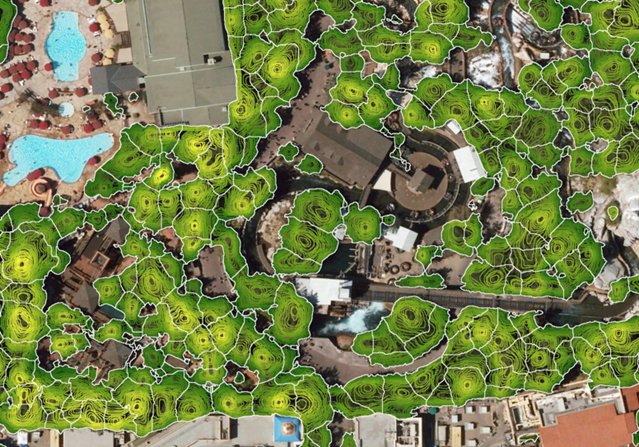
Get a Timely Assessment of Vegetation Coverage Over Your Project Area
Land Info’s Vegetation Geodata uses the latest satellite and aerial imagery to produce detailed 2D and 3D tree canopy mapping. Individual tree crowns are contoured with detailed height information when combined with 3D elevation. Additional insights include tree structure and health and estimates of tree trunk locations and understory clearances.
This true-to-real-world mapping supports more accurate risk assessments, targeted interventions, and better resource allocation, making it ideal for utility vegetation management, urban forestry, and conservation efforts.
Land Info’s Vegetation Geodata Provides the Inputs Needed for Maintenance Programs
The tree canopy is ever-changing and a constant pain point for managers trying to stay one step ahead with proper maintenance. They must accurately assess existing conditions and future budgeting and resource allocation forecasts.
Land Info delivers actionable geospatial intelligence that’s both quantitative and visual. Areas impacted are calculated, mapped, and ready for import into leading assessment and work order management systems.
Who uses Land Info’s Vegetation GeoData:
Electric Utilities: Up-to-date tree canopy data from recent satellite and aerial imagery enables precise, proactive powerline vegetation management and tree trimming, reducing the risk of outages and enhancing safety.
Urban Foresters: Tree density models for urban forestry provide critical insights to enhance green space equitably, reducing heat effects and improving living conditions in cities.
Stormwater Managers: 2D vegetation land cover models enable accurate assessment of hard surfaces’ impact on stormwater runoff, helping to implement effective mitigation strategies and assess conditions to the individual parcel level.
Solar Energy Consultants: Detailed 3D Tree Canopy models provide precise insights into vegetation shadowing effects (including seasonal change and future growth), enabling accurate assessment of potential solar energy output and optimal panel placement.
Telecommunications RF Engineering: 3D contoured trees provide precise vegetation location data for optimizing RF network planning and design, ensuring better coverage and reduced signal interference.
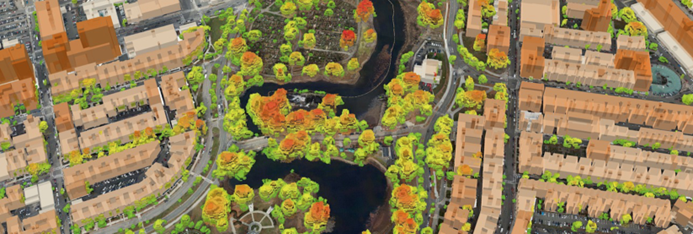
3DTree Crowns & Contours with 3D Buildings (add-on/extra)
Vegetation GeoData Product Options:
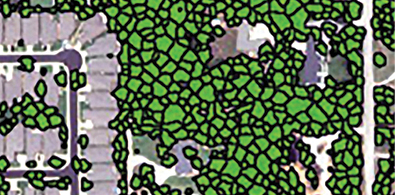
2-Dimensional – Canopy with Tree Crowns
Land Info offers 2D vegetation classification datasets designed explicitly for vegetation and stormwater management professionals needing cost-effective, large-area coverage. These datasets provide highly accurate mapping of tree canopies, including individual tree crowns.
This data is customizable, affordable, and scalable, making it a valuable tool for optimizing vegetation management operations and other analyses across large areas.

3-Dimensional – Canopy with Tree Crowns
with Contours and Tree Trunks
Land Info offers advanced 3D vegetation analysis enabled by stereo imagery from satellite or aircraft or via LiDAR point clouds captured via USGS’s 3DEP or other government programs.
This data includes rich attributions such as mean, max, and min tree heights and optional tree trunk location estimations.
Vegetation GeoData – Extras
- Understory Modeling
- Tree Canopy Density
- Future Growth Modeling
- Deciduous versus Conifer Types
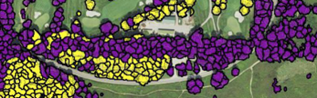
Terrapin Geographic, Inc.
How Land Info Makes Vegetation GeoData:
Land Info uses advanced object-based image analysis (OBIA) techniques based on the latest machine learning algorithms. This service enables the fusion of 3D elevation data with a detailed vegetation classification to create a 2D or 3D dataset of your service area.
To achieve the best 3D results, Land Info leverages its archive of the most currently available digital terrain and 3D point cloud databases with earth imagery from the best private and publicly available sources over your project area.
Using Land Info’s Vegetation GeoData allows for precise monitoring and management of vegetation, enhancing the efficiency of asset maintenance and management. This technology enables proactive decision-making by providing accurate, large-scale insights into tree growth patterns and potential risks.